

On this pageBrowse sections
What stable tells you and what it does not
Short answer in a hospital, stable usually means the care team does not see an immediate decline at that moment. It does not mean the patient is cured, free from risk or ready to go home. The meaning depends on the illness, recent changes, treatments being used and the next care decision.
The short meaning of stable
Hospital teams use the word stable as a brief update. In everyday language, it often sounds like everything is fine. In clinical care, it is usually narrower: the patient is not showing a major immediate change, or the current plan is keeping important body functions steady enough for the present setting.
There is no single definition that fits every patient and every hospital situation. A clinician should explain what is stable, how long it has been stable and what support is helping. A person can be seriously ill and still be described as stable if the condition has not recently worsened.
That is why the most useful follow up is not simply whether the patient is stable. It is asking what has changed and what the team expects next.
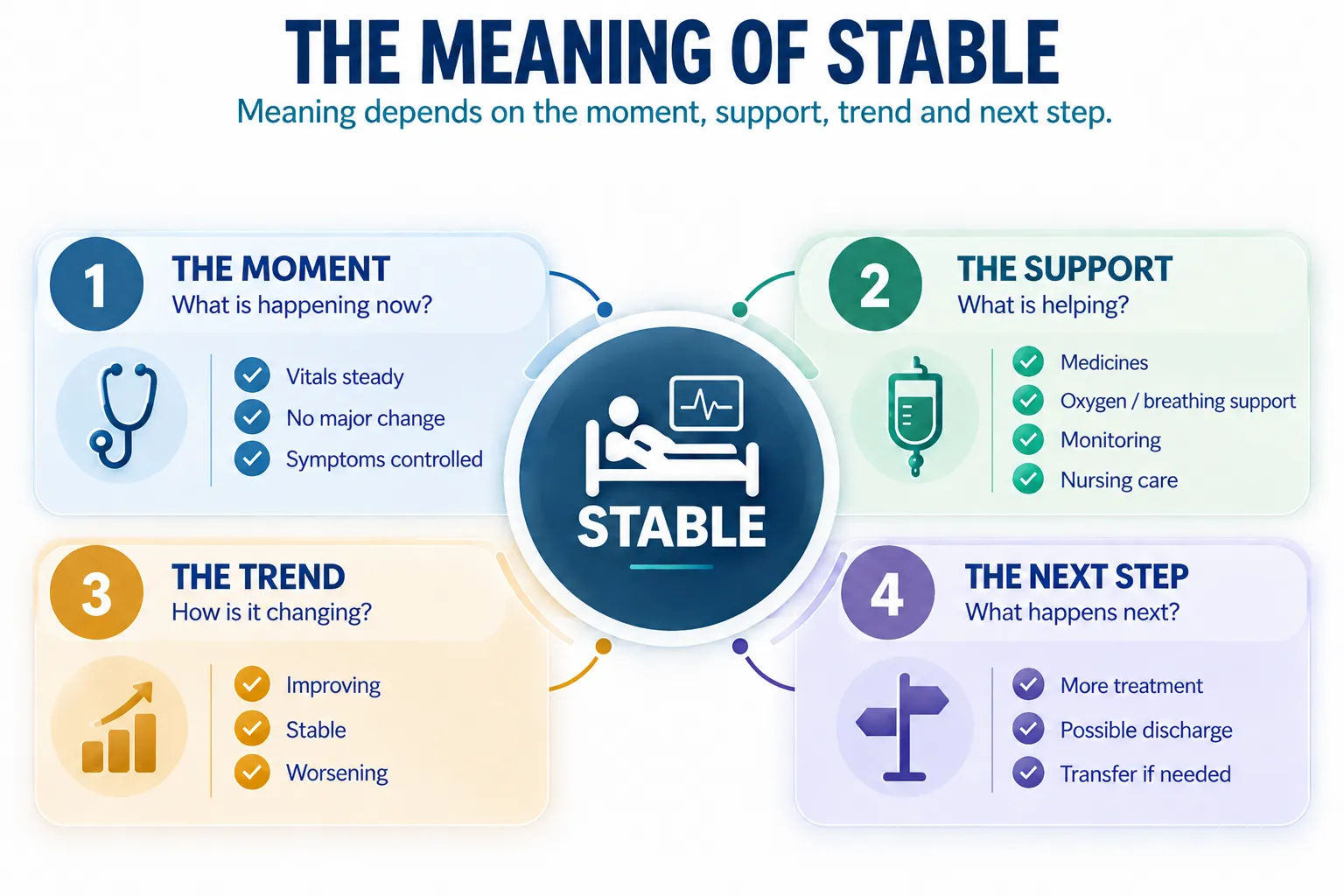
Stable in a snapshot. The trend and the level of support give the word its meaning.
What the care team checks
Doctors and nurses do not decide that someone is stable from one number. They combine measurements with the bedside examination, symptoms, test results and the patient’s response to treatment.
Important body functions
Vital signs show how the body is functioning. They commonly include blood pressure, heart rate, breathing rate, temperature and oxygen level. The care team looks at the values and at how they change over time. A reading that is expected for one patient may be concerning for another, so the pattern matters more than a generic chart.
Symptoms and awareness
The team also watches how the patient looks and feels. New confusion, increasing pain, harder breathing, faintness, weakness or reduced alertness may matter even before a monitor shows a large change.
Treatment and support
A patient may look steady because treatment is working. Oxygen, intravenous fluids, medicine, dialysis or other support can be part of the reason. Stable while receiving support is different from stable without it. This does not make the update inaccurate, but it changes what the word means.
The direction over time
A single reading is a moment. Several readings create a trend. The team asks whether the patient is improving, staying about the same or beginning to worsen, and whether treatment needs to change.
Why context changes the meaning
Stable is always tied to a place, a time and a decision. A person may be steady enough for a hospital floor but still need continuous treatment. Another patient may be steady enough to move from a higher level of care to a regular room. A third may be medically ready to leave only after the discharge plan is safe.
Stable in a higher level of care
In an intensive care setting, a patient can remain very ill while medicines and machines keep the body supported. Here, stable may mean there has been no sudden decline, not that the danger has passed.
Stable on a hospital floor
On a regular hospital unit, stable may mean the patient can continue with planned monitoring and treatment without an urgent move to more intensive care. The team still checks for changes and may adjust the plan as new information arrives.
Stable after treatment
After a procedure, new medicine or other treatment, stable may mean the expected recovery is continuing without a new warning sign. The care team may still need more time, repeat testing or a trial with less support.
For healthcare organizations
Clear bedside communication depends on dependable clinical teams. WCGTX supports Texas hospitals, emergency rooms and urgent care centers with physician staffing and program support.
Explore WCGTX healthcare staffing solutions • Request a staffing consultation
What stable does not mean
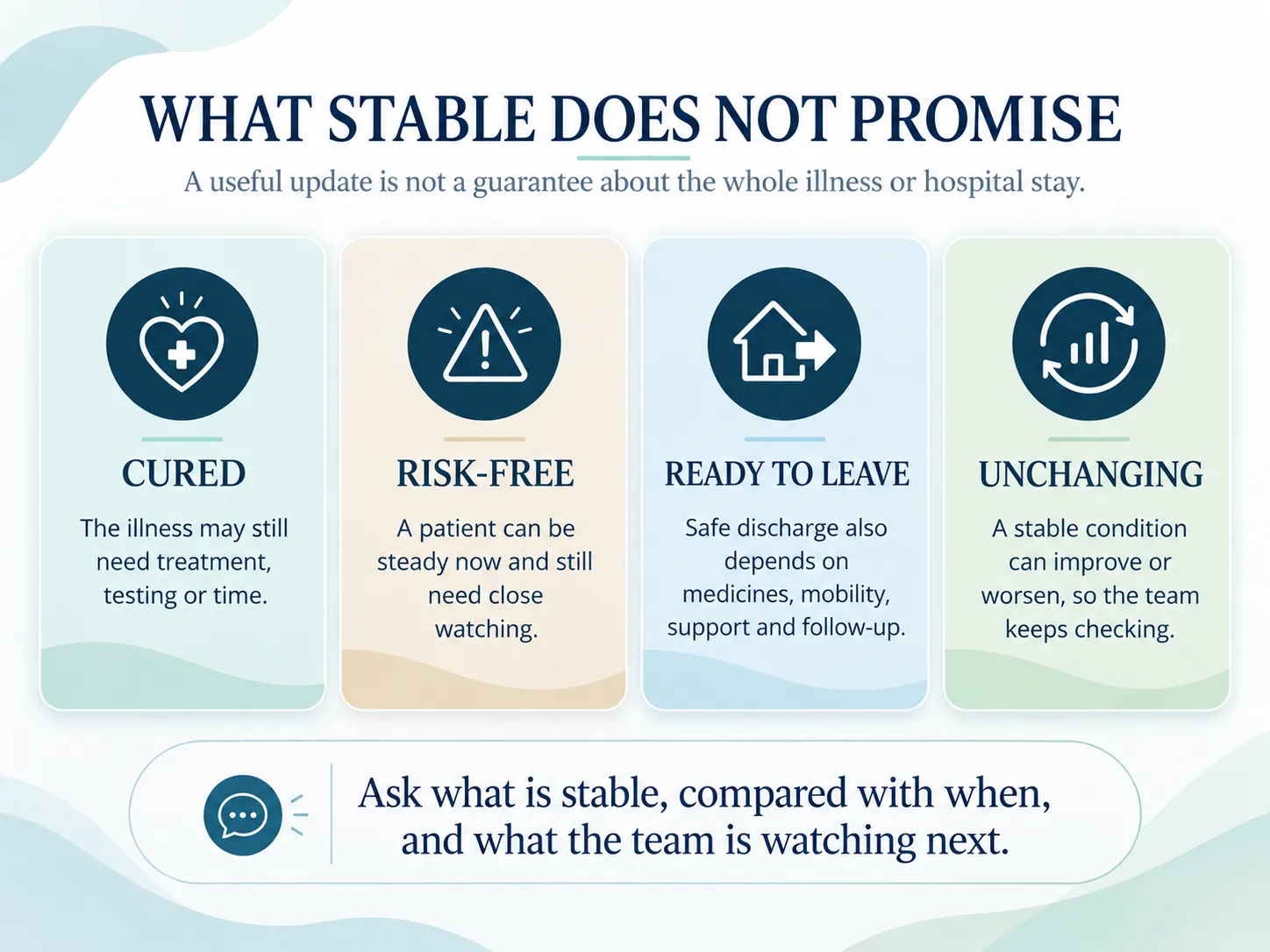
Stable is useful information, but it is not a guarantee about recovery or discharge.
The word should never replace a clear explanation. Families deserve to know whether the patient is still seriously ill, which problems remain and what would count as progress.
-
Stable does not necessarily mean the illness has been cured.
-
Stable does not mean every test result is normal.
-
Stable does not remove the need for monitoring or treatment.
-
Stable does not guarantee that the condition will stay the same.
-
Stable does not by itself mean the patient can safely leave the hospital.
Stable for monitoring transfer and discharge
Monitoring in the same room
If the current condition and treatment needs fit the hospital unit, the team may continue the same plan and watch the trend. This is still active care. A change in symptoms or measurements may lead to new tests, treatment or a different level of monitoring.
Moving to another unit or facility
Stable for transfer means the team believes the move can be made with an appropriate plan, staff and support. It does not always mean the medical problem is resolved. The receiving setting must be able to provide the care the patient still needs.
Going home or to another care setting
Safe discharge involves more than steady vital signs. The hospital considers the patient’s current needs, medicines, ability to move and care for daily needs, follow up, equipment, home support and warning signs. Federal hospital guidance also calls for patients and caregivers to be involved in discharge planning and for the plan to match the patient’s goals and treatment preferences.
Before leaving, patients should receive clear instructions about medicines, activity, follow up appointments, who to call and when to seek urgent help. If part of the plan is unclear, ask the team to explain it again in plain language.
When to alert the care team
Tell a nurse or clinician promptly if the patient feels worse or develops a new symptom. Do not wait for the next scheduled check when something feels wrong.
-
New or harder breathing
-
Chest pain, fainting or sudden severe weakness
-
New confusion, unusual sleepiness or difficulty waking
-
Pain that is suddenly worse or not controlled
-
A sudden change in speech, movement, skin color or behavior
-
Any symptom the care team specifically asked you to report
In the hospital, use the call button or notify staff. After discharge, follow the written instructions. Call emergency services for severe or life-threatening symptoms.
Frequently asked questions
Does stable mean the patient is out of danger?
Not always. It may mean there is no immediate decline, while the illness remains serious or needs continued treatment. Ask the team which risks are still present.
Can someone be stable and still be in intensive care?
Yes. A patient may be steady because intensive monitoring, medicine or equipment is supporting the body. The level of support is part of the meaning.
Does stable mean all vital signs are normal?
No. The team interprets the numbers in the context of the patient’s usual health, diagnosis, treatment and trend. One number cannot describe the whole condition.
Can a stable patient suddenly get worse?
Yes. Illness can change. Hospitals continue monitoring because a person who is stable now may improve or worsen later.
Why will the hospital not give a firm discharge time?
Discharge depends on the patient’s clinical progress and on a safe plan for medicines, follow up, support and the next care setting. Those pieces may change during the day.
What is the best question to ask after hearing stable?
Ask, ‘Stable compared with when, and what are you watching next?’ That invites a clearer explanation of the trend and the plan.
A clearer way to hear the word stable
Think of stable as a time stamped update, not a final result. It says something about the patient’s condition now, within the support and monitoring available. The fuller picture comes from the trend, the treatment still needed and the next safe step.
Patients and families do not need to decode hospital shorthand on their own. Ask what the word means for this person today. Clear questions help the care team give a clearer answer.
Sources
-
Agency for Healthcare Research and Quality: Transitions of Care
-
Agency for Healthcare Research and Quality: Questions Are the Answer
-
Centers for Medicare and Medicaid Services: Hospital Discharge Planning Requirements
Medical disclaimer: This article provides general education and does not replace advice from the patient’s own care team. Individual conditions and treatment plans vary.
Sources reviewed November 2, 2026. Medical guidance and hospital procedures may change, so patients should follow their own care team’s instructions.
Written by: WCGTX Editorial Team